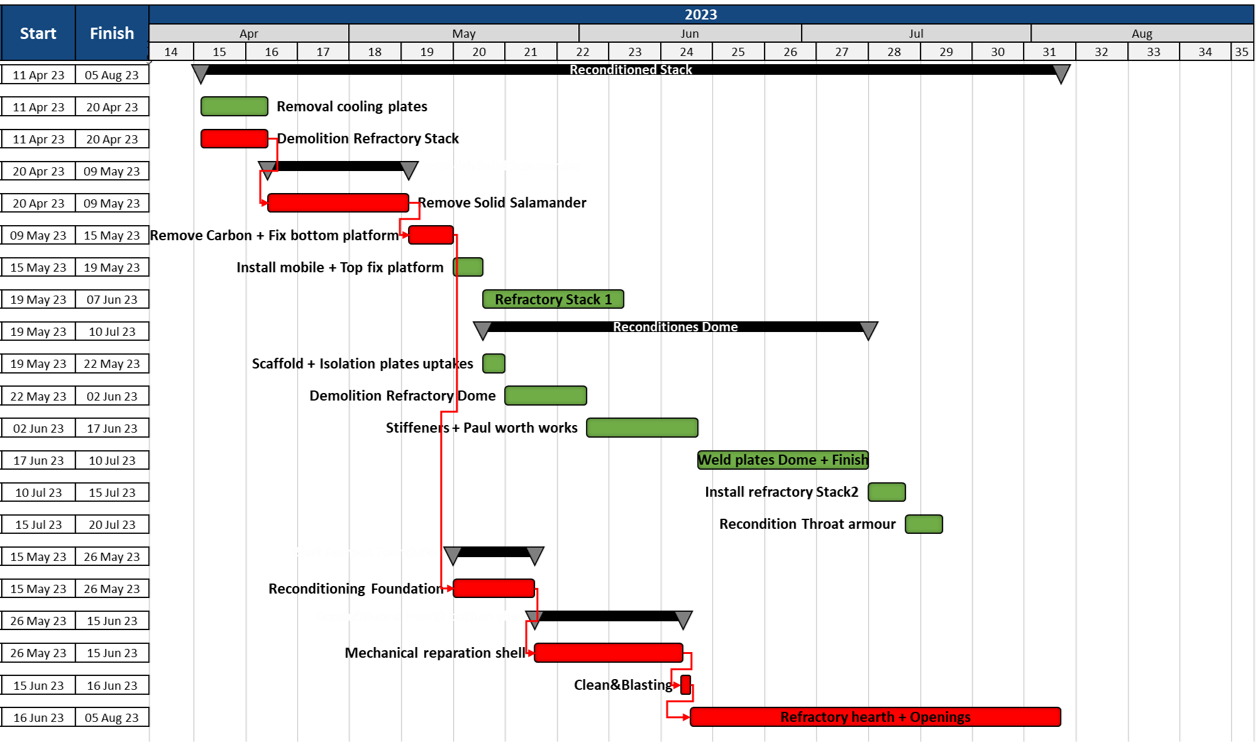
Description
The As-Planned vs As-Built Windows Analysis method is one of the methods that apply segmentation or windows analysis. Unlike TIA or TSA, this methodology is less dependent on planning software and is applied when the quality of the baseline or the updates is not adequate.
As in APAB, executed dates are compared with planned dates, but the project is divided into sections or windows. These windows are analysed by reviewing contemporary programmes, site minutes and all available information that allows the delay events and the critical path to be assessed.
The expert determines the contemporary critical path for each window by applying experience and the available information. The reasoning followed to define the critical path is especially important.
The delay in each window is determined by comparing milestones or key dates between the contemporary schedule and the baseline, and then identifying which events caused that delay as well as who was responsible.
The advantage of carrying out the analysis over several periods of time is that the identification of delays or accelerations can be much more accurate. The more periods are defined, the closer the analysis will be to reality. The definition of the windows should be based on relevant milestones or changes in criticality.
Strengths
- The advantage of carrying out the analysis over several periods of time is that the identification of delays or accelerations can be much more accurate and easier to explain and understand.
- It does not require many resources to perform and can produce an acceptable and defensible result in a short period of time. The use of planning software is not necessary.
- The documentation required to carry out this analysis is another advantage. Only the as-built dates, the agreed planning and the justification for delays on the critical path of the completed project are required. When this method is applied to prepare expert reports, the documentation should be as complete as possible in order to support the expert's opinion.
Weaknesses
- It is not appropriate for projects with activities that have little total float, or in other words, with several subcritical paths.
- It does not consider that changes to the baseline may have been the real cause of the delay rather than specific delay events, and it is not a good method in cases of concurrent delay.
- It depends on the knowledge, experience and judgement of the specialist carrying out the analysis.
- It ignores the prospective critical paths in contemporary programmes and the critical decisions that may have been made based on them.